• Skip to primary navigation
  • Skip to main content
  • Skip to footer

Zenith Medical

Mon-Fri: 8am-1pm & 6pm-9.30pm
Sat: 8am-1pm
Sun: 6pm-9.30pm (Walk in only)
266C Punggol Way, #01-374, S(823266)
Google Map of 1.4051410378847566, 103.89754985575564
  • Book Appointment
  • Services
    • See Psychologists
    • Minor Surgery
    • ENT
    • Ingrown Toenail Treatment
    • Paediatrics
    • Baby Vaccines
    • STD Screening
    • Blood Test
  • Charges
  • Patient Education
    • Allergic Rhinitis
    • Chronic Back Pain
    • Foot Pain
    • Neck Pain
    • Post- Earwax Cleaning Care Instruction
    • Shoulder Pain
    • Vertigo
  • Symptom Check
    • Depression?
    • Obsessive Compulsive Disorder (OCD) ?
    • Earwax?
    • Anger Management Problems?
    • Middle Ear Infection?
    • Earpain or Outer Ear Infection?
    • Constipation in Adults
    • GP First — Food Allergies
  • Mental Health
    • See a Psychologist
    • Do I have Depression
    • Do I have Anxiety Disorder?
    • Individual Psychotherapy Service Agreement
    • Duty To Warn and Confidentiality
  • Courses
    • ACT for Adolescents – June Workshop
    • Nurturing Inner Calm: Mindfulness Practices for Children
    • Building Emotional Skills in Children: Managing Anxiety and Anger
  • Refer
  • Our Team
    • Doctors
    • Psychologists
      • Charmaine Eng
      • Annette Chen
      • Tan Yan Lin
      • Stephanie Lee
      • Nyein Nyein
      • Ng Eng Chuan
    • Family and Marital Therapist
    • Values
    • Join Us

Patient Education

23 June, 2026 by crystal ang

Foot Pain

👣 Foot Pain Relief: Simple Exercises for Plantar Fasciitis

Plantar fasciitis is a common cause of heel and foot pain. It happens when the thick band under your foot (called the plantar fascia) becomes tight or irritated.

The good news is — simple daily stretches can help reduce pain and speed up recovery.


🧘‍♂️ 1. Towel Stretch

Best done: First thing in the morning

Steps:

  1. Sit with your leg straight.
  2. Loop a towel around the ball of your foot.
  3. Gently pull the towel towards you.
  4. Keep your knee straight.
  5. Hold for 20–30 seconds.
  6. Repeat 3 times.

🦵 2. Calf / Achilles Stretch

Best done: 2–3 times daily

Steps:

  1. Stand facing a wall.
  2. Place one leg behind you.
  3. Keep your back knee straight and heel on the ground.
  4. Lean forward until you feel a stretch in your calf.
  5. Hold for 20–30 seconds.
  6. Repeat 3 times each side.

🪜 3. Stair Stretch

Best done: Daily

Steps:

  1. Stand on a step with your heels hanging off the edge.
  2. Hold onto a railing for balance.
  3. Slowly lower your heels down.
  4. Feel the stretch in your calves and foot.
  5. Hold for 20–30 seconds.
  6. Repeat 3 times.

🦶 4. Toe Stretch

Best done: Before walking after rest

Steps:

  1. Sit comfortably.
  2. Cross one foot over the other knee.
  3. Hold your toes and gently pull them backwards.
  4. You should feel a stretch in the arch.
  5. Hold for 15–20 seconds.
  6. Repeat 3 times.

🧊 5. Frozen Can Roll

Best done: After activity or when painful

Steps:

  1. Place a frozen water bottle or can on the floor.
  2. Roll your foot over it slowly.
  3. Apply gentle pressure.
  4. Do this for 5–10 minutes.
  5. Repeat 1–2 times daily.

✅ Simple Tips for Faster Recovery

  • Wear supportive shoes (avoid walking barefoot)
  • Avoid prolonged standing when possible
  • Stretch twice daily consistently
  • Reduce high-impact activities (e.g. running)

⚠️ When to See a Doctor

  • Pain lasts more than 2–3 weeks
  • Pain is severe or worsening
  • Difficulty walking
  • Swelling or redness present

Filed Under: Patient Education Tagged With: patient-knowledge, physiotherapy, Plantar-Fasciitis

23 June, 2026 by crystal ang

Vertigo

Vertigo: Why the Room Feels Like It’s Spinning

Vertigo is a feeling that you or the room is spinning, even when you are not moving.

It can feel scary, but most of the time it is not dangerous and can get better with simple treatment.


🌪 What is Vertigo?

Vertigo is a type of dizziness.
Instead of just feeling lightheaded, you feel like:

  • The room is spinning
  • You are moving when you are not
  • You may lose your balance

The most common type is called Benign Positional Vertigo (BPPV).

👉 “Benign” means not serious
👉 “Positional” means it happens with certain head movements


🧠 What Causes It?

In most people, the cause is unknown, but it can happen after accidents that injure the neck or head. 

There are two ways to understand why it happens: 

  1. A problem exists in the neck, usually a ‘kink’ in some of the swivel joints of the nexk. This dizziness happens because the neck is connected to the balance centre by special nerve pathways. 
  2. There are tiny pieces of floating debris (possibly calcium carbonate crystals) in the balance centre of the inner ear, known as the labyrinth. When disturbed, these crystal debris upset the balance centre.  

🤢 Common Symptoms

You may feel:

  • Sudden spinning sensation
  • Dizziness when turning your head
  • Nausea (feeling like vomiting)
  • Loss of balance
  • Symptoms lasting seconds to minutes

⚠️ What Triggers Vertigo?

Vertigo often happens when you:

  • Look up or down
  • Turn your head quickly
  • Roll in bed
  • Get up from lying down
  • Lie on one side

👵 Who Gets Vertigo?

  • Can happen at any age
  • More common in older adults
  • Slightly more common in women

⏱ How Long Does It Last?

  • Each episode usually lasts a few seconds to 1 minute
  • It may come and go over weeks
  • Most people improve over time

💡 How to Manage Vertigo

1. Avoid sudden movements

Move your head slowly and carefully.


2. Sit or lie down when dizzy

Prevent falling or injury.


3. Keep your home safe

  • Avoid slippery floors
  • Use support when walking if needed

4. Try special exercises (doctor-guided)

Doctors may teach you simple head movements to:
➡️ Move the crystals back into place
➡️ Stop the spinning

These are called:

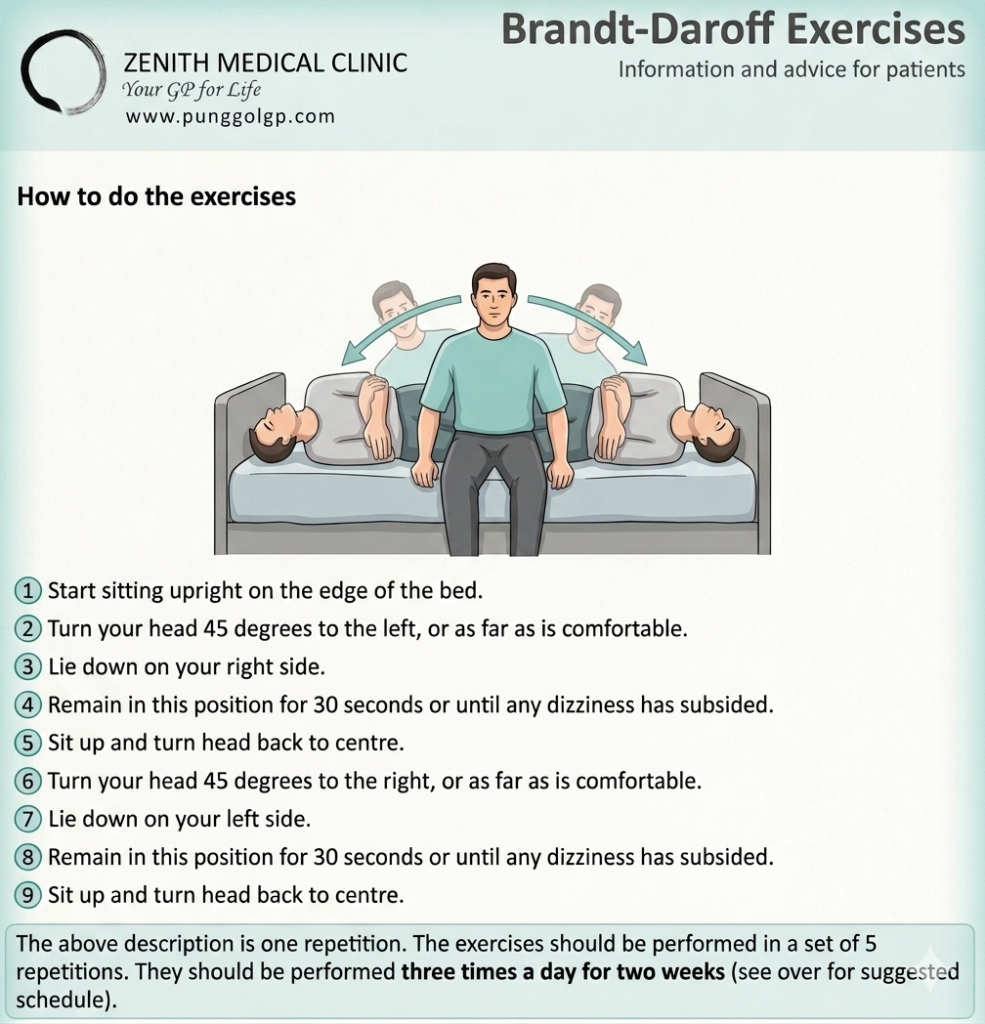
  • Epley manoeuvre
  • Brandt-Daroff exercises

🚗 Important Safety Tip

Avoid:

  • Driving
  • Climbing heights
  • Operating machines

👉 Until your symptoms improve


🚨 When to See a Doctor

See a doctor if:

  • Vertigo keeps coming back
  • You cannot balance properly
  • You have frequent vomiting
  • It affects your daily life

❗ Seek Help Immediately If

You also have:

  • Severe headache
  • Weakness in your arms or legs
  • Trouble speaking
  • Double vision
  • Fainting

👉 These may be signs of something more serious


🌟 Final Message

Vertigo can feel frightening, but it is usually treatable and not dangerous.

With the right care:
✔ Symptoms improve
✔ Balance returns
✔ You can go back to normal activities


🧠 Simple Rule to Remember

👉 Move slowly
👉 Sit when dizzy
👉 Get help if unsure

Brandt–Daroff Exercises for Vertigo (Simple Guide)

These exercises help reset your balance by moving tiny crystals in your inner ear back to the right place.

👉 Do this 2–3 times a day
👉 Each session takes about 10 minutes


🧘‍♂️ Step-by-Step Instructions

Step 1: Start Sitting

  • Sit upright on the edge of your bed
  • Keep your back straight

Step 2: Turn Your Head

  • Turn your head about 45° to one side (slightly looking to the side)

Step 3: Lie Down Quickly

  • Quickly lie down on the opposite side
    (Example: if head turned left → lie on right side)
  • Keep your head angled upward

⏱ Stay here for 20–30 seconds
👉 Or until dizziness stops


Step 4: Sit Back Up

  • Return to sitting position
  • Wait 20–30 seconds

Step 5: Repeat Other Side

  • Turn head to the other side
  • Lie down on the opposite side
  • Hold again for 20–30 seconds

🔁 How Many Times?

  • Repeat 5 times on each side
  • Do this 2–3 times daily

⚠️ What You May Feel

  • You may feel dizzy during the exercise
    👉 This is normal and expected
    👉 It usually improves after a few days

🚨 Important Tips

  • Move quickly when lying down, but safely
  • Stay calm and breathe normally
  • Stop if symptoms become too severe
  • Do this on a bed, not the floor

🧠 Simple Rule to Remember

👉 Turn → Drop → Wait → Sit → Repeat

Filed Under: Patient Education Tagged With: patient-knowledge, Vertigo

23 June, 2026 by crystal ang

Shoulder Pain

 🦴 Simple Exercises for Shoulder Pain

If your shoulder feels painful, stiff, or hard to move, don’t worry.
Most shoulder pain improves with time and gentle movement.

These simple exercises can help you:

  • Reduce pain
  • Improve movement
  • Speed up recovery

👉 Try to do them 2–3 times a day
👉 Move slowly and stop if you feel sharp pain

👉 Follow Dr Kevin Yang to do these exercises for shoulder pain.

✅ Exercise 1: Straight-Arm Rotation

What this helps: Loosens your shoulder joint

How to do it:

  • Bend forward slightly
  • Let your arm hang down relaxed
  • Move your arm in small circles
  • Do circles:
    • Clockwise
    • Anti-clockwise

👉 Do 10 circles each direction


✅ Exercise 2: Shoulder Stretch

What this helps: Stretches tight shoulder muscles

How to do it:

  • Bring your sore arm across your chest
  • Use your other hand to hold it
  • Gently push your arm closer to your body

👉 Hold for 10–15 seconds
👉 Repeat 3–5 times


✅ Exercise 3: Shoulder Winging

What this helps: Improves shoulder control and posture

How to do it:

  • Put both hands behind your head
  • Pull your elbows back
  • Keep your chest open

👉 Hold for 5 seconds
👉 Repeat 5–10 times


✅ Exercise 4: Coupled Arm Swing

What this helps: Helps movement if one shoulder is painful

How to do it:

  • Lie on your back
  • Use your good arm to support your injured arm
  • Lift both arms up over your head
  • Then slowly bring them back down

👉 Repeat 5–10 times


✅ Exercise 5: Towel Exercise

What this helps: Improves flexibility behind your back

How to do it:

  • Hold a towel behind your back
  • One hand holds the top, the other holds the bottom
  • Use your good arm to gently pull the towel

👉 Move your injured arm up and down gently
👉 Repeat 5–10 times


⚠️ Important Tips

  • ✔ Mild discomfort is okay
  • ❌ Sharp pain → STOP immediately
  • ✔ Keep movements slow and controlled
  • ✔ Do exercises daily for best results

🧠 When Should You See a Doctor?

See a doctor if:

  • Pain is severe
  • Shoulder is very stiff or locked
  • Pain lasts more than 2–3 weeks
  • You had a fall or injury

🌟 Final Advice

Your shoulder heals best with gentle movement, not complete rest.
Stay consistent — small daily effort makes a big difference.

Filed Under: Patient Education Tagged With: Good-Posture, healthy-habits, life-wisdom, physiotherapy

23 June, 2026 by crystal ang

Neck Pain

Neck Pain: Simple Ways to Feel Better

Your neck supports your head all day.
Looking down at phones, working on computers, or poor posture can strain your neck.

The good news is — most neck pain can improve with simple habits and gentle exercises.


🤕 Why Does Neck Pain Happen?

Neck pain can be caused by:

  • Looking down at your phone for too long
  • Sitting with poor posture
  • Sleeping in an awkward position
  • Sudden strain or muscle tightness
  • Stress causing tight muscles

⚠️ Common Symptoms

You may feel:

  • Pain or stiffness in your neck
  • Difficulty turning your head
  • Headaches (especially at the back of your head)
  • Tight shoulders
  • Pain when looking up, down, or sideways

💡 Simple Daily Tips

1. Keep your head upright

Try not to bend your neck forward too much.

👉 Tip: Bring your phone up to eye level
👉 Keep screens at eye level when working


2. Take breaks often

Do not stay in one position too long.

👉 Move every 30–60 minutes
👉 Stretch your neck gently


3. Sleep well

Use a pillow that supports your neck.

👉 Avoid sleeping with too many pillows
👉 Keep your neck in a natural position


4. Relax your shoulders

Tension in your shoulders can worsen neck pain.

👉 Drop your shoulders and relax
👉 Avoid hunching forward


🧘 Simple Neck Exercises

Do these slowly and gently.
Stop if you feel sharp pain.

Practice these exercises for neck pain with Dr Kevin Yang.

1. Neck Rotation (Turn Side to Side)

  1. Lie on your back on a firm surface like a bed or floor.
  2. Turn your head slowly to one side.
  3. Hold for 3–5 seconds.
  4. Turn to the other side.

👉 Repeat 5 times each side


2. Side Stretch

  1. Sit upright.
  2. Tilt your head toward one shoulder.
  3. Do not lift your shoulder.
  4. Hold for 5 seconds.

👉 Repeat on both sides.


3. Chin Tuck (Very Important)

  1. Sit straight.
  2. Pull your chin backward (like making a “double chin”).
  3. Hold for 3–5 seconds.
  4. Trust your chin forward.
  5. Hold for 3–5 seconds.

👉 Repeat 5–10 times.

✔ Helps correct posture
✔ Reduces strain from phone use


4. Gentle Neck Resistance

  1. Place your hand on your forehead.
  2. Gently press your head forward.
  3. Resist with your hand (do not move your head).
  4. Hold for 3 seconds.

👉 Repeat on:

  • Front
  • Back
  • Each side

5. Resisted Rotation

  1. Lift your shoulders up.
  2. Hold for a moment.
  3. Relax and drop them down.

👉 Repeat 5–10 times


6. Shoulder Rolls

  1. Roll your shoulders forward five times.
  2. Roll them backward five times, in a circular motion to release tension.

❌ What to Avoid

  • Looking down at your phone for long periods
  • Sudden jerky neck movements
  • Carrying heavy bags on one shoulder
  • Sleeping in awkward positions
  • Sitting too long without movement

🧠 Simple Rule to Remember

👉 Keep your head up
👉 Move often
👉 Do gentle stretches daily


🚨 When to See a Doctor

Seek medical help if:

  • Pain lasts more than 1–2 weeks
  • Pain is severe or getting worse
  • You feel numbness or weakness in your arms
  • Pain spreads down your arm
  • You have fever or recent injury

🌟 Final Message

Most neck pain improves with:
✔ Good posture
✔ Regular movement
✔ Simple exercises

Take care of your neck daily,
and it will take care of you.

Filed Under: Patient Education Tagged With: Good-Posture, healthy-habits, life-wisdom, Neck-Pain, physiotherapy

23 June, 2026 by crystal ang

Allergic Rhinitis

🌿 What is Allergic Rhinitis?

Allergic rhinitis (AR), also known as nose allergy, happens when your body reacts to things in the air like dust, pollen, or pet fur.

Your body treats these as harmful and releases chemicals that cause irritation in your nose and eyes.

🏠 How to Reduce House Dust Mites at Home

Dust mites cause 90% of allergic rhinitis in Singapore.


🛏 Bedroom Tips

  • Use dust-mite proof covers for pillows and mattresses
  • Wash above covers weekly in hot water above 60 degrees
  • Limit soft toys on the bed (wash them regularly if kept)

🧹 In the Home

  • Mop floors instead of sweeping
  • Remove carpets, heavy curtains, and clutter
  • Reduce the number of stuffed toys in the home, as they trap dust easily

🌬 Reduce humidity

  • Use a dehumidifier and maintain humidity less than 50%
  • Especially in the bedroom

🧠 Simple Daily Routine for AR Control

  • Clean your nose regularly (saline rinse)
  • Keep your room clean and dust-free
  • Avoid known triggers
  • Take medication if prescribed
  • Follow up with your doctor if symptoms persist

🚨 When Should You See a Doctor?

Seek medical advice if:

  • Symptoms do not improve
  • You have poor sleep due to nasal blockage
  • You get frequent sinus infections
  • Symptoms affect your daily life, school, or work

References

Bousquet J, Khaltaev N, Cruz AA, et al. Allergic Rhinitis and its Impact on Asthma (ARIA) 2008 update. Allergy. 2008;63(Suppl 86):8–160.

Wise SK, Damask C, Roland LT, et al.
International Consensus Statement on Allergy and Rhinology: Allergic Rhinitis 2023.
Int Forum Allergy Rhinol. 2023;13:293–859.

Dykewicz MS, Wallace DV, Amrol DJ, et al.
Rhinitis 2020: A Practice Parameter Update.
J Allergy Clin Immunol. 2020;146(4):721–767.

Filed Under: Patient Education Tagged With: Allergic-Rhinitis, Allergy

19 June, 2026 by crystal ang

Chronic Back Pain

Treat Your Back with Respect

Your back works hard for you every day. It helps you sit, stand, walk, bend, lift, and sleep. When you treat your back well, it can stay strong and comfortable for longer. Back pain is common, but many cases can be improved by using good posture, moving often, lifting safely, and doing simple exercises. 

Small habits can make a big difference.

Why your back matters

Your back supports your whole body. It also helps protect your spine, which carries messages between your brain and the rest of your body. When your muscles are weak, tight, or overworked, your back can start to hurt.

Here are some good daily habits that can help lower strain on your back:

Everyday habits that help your back

1. Lift with care

When lifting something heavy:

  • bend your knees
  • keep your back straight 
  • hold the item close to your body
  • avoid twisting the body while lifting

A good rule is:
Bend your knees, keep it close, stand up slowly.

2. Do not stay in one position too long

Standing too long, sitting too long, or even walking with poor posture can make your back feel sore.

Try to:

  • change position often
  • stand up and stretch every so often
  • take short walks if you have been sitting for a long time
  • wear low-heeled shoes
  • walk with good posture: chin tucked in, head held high and toes pointing forward

3. Practice good sitting habits

  • use chairs that support you to sit upright
  • knees should be levelled with your hip
  • you should be able to keep both feet flat with thighs parallel to the floor
  • use a rolled-up towel or lumbar support to reduce pressure on your spinal discs
  • avoid hunching, slumping or learning too far forward 

4. Be kind to your back while standing

  • stand tall with your shoulders relaxed
  • spread your weight evenly on both feet
  • if you must stand for a long time, shift your position now and then

5. Sleep in a supportive position

  • sleep on a firm mattress appropriate for your weight
  • side sleepers may bend your knees so they touch on top of each other
  • back sleepers may place a pillow under your knees

Many people find it more comfortable to sleep on their side or on their back with good support.

Back habits to avoid

These habits can put extra strain on your back:

  • bending forward from the waist to lift things
  • twisting your body while carrying something heavy
  • sitting in a slouched position
  • standing still for very long periods
  • sleeping in a poor position with little support
  • using a chair or mattress that does not support your back well

Simple back exercises

These exercises strengthen the back muscles which support your spine. Do these exercises diligently for three months to greatly reduce persistent chronic back pain.

You may do these exercises on a padded surface, well-carpeted floor or yoga mat. Move gently and stop if the pain becomes worse.

  • Do these exercises twice a day, at least 5 minutes.
  • Rest between each exercise.
  • Do not strain.
  • The exercise may be uncomfortable initially, with practice, it will become more natural and enjoyable.

Exercise 1: Splinting the lumbar spine

Learn to keep the lumbar spine in a fixed position using your abdominal and spine muscles.

  1. Lie flat with a hand under your neck.
  2. Keep your knees bent.
  3. Suck in your stomach until your back presses against the floor, buttocks slightly raised
  4. Hold your breath and count to 6. Relax.
  5. Repeat 10 times.

Exercise 2: Back arch

  1. Stand straight with feet pointing forward, shoulders-width apart.
  2. Place your hands on the small of your back.
  3. Slowly breathe in and out.
  4. Breathe out, bend back as far as you can and keep your knees straight.
  5. Hold the lower back arched to a count of 5.
  6. Return to neutral.
  7. Repeat 5 times.

Exercise 3: Knee-to-chest

  1. Lie on your back.
  2. Bring one knee toward your chest and hold for a few seconds. 
  3. Lower it down, then repeat with the other leg.

Exercise 4: Straight-leg raise

  1. Lie on your back with one leg straight. 
  2. Slowly lift that leg as high as you comfortably can. 
  3. Lower it down gently, then repeat on the other side.
  4. Do this to the limit of your pain. 

Exercise 5: Pelvic roll

  1. Lie on your back with your knees bent. 
  2. Gently roll both knees to one side. 
  3. Bring them back to the middle, then roll them to the other side.

When to get medical help

Back pain should be checked by a doctor if:

  • it is very severe
  • it keeps getting worse
  • it started after a fall or injury
  • you have weakness or numbness
  • you have trouble walking
  • you cannot control your bladder or bowels
  • you also have fever or feel very unwell

Final message

Treat your back with respect every day. 

Lift carefully. Sit well. Move often. Sleep with support. 

Do simple exercises to keep your back strong.

A few smart habits each day can help you stay active, comfortable, and free from back pain.

References

Qaseem A, Wilt TJ, McLean RM, Forciea MA. Noninvasive Treatments for Acute, Subacute, and Chronic Low Back Pain. Ann Intern Med. 2017;166(7):514-530.

Filed Under: Patient Education Tagged With: chronic-back-pain, life-wisdom, patient-knowledge, physiotherapy

Next Page »

Footer


Book Appointment with Zenith Medical Clinic
  • Home
  • Our Values
  • Doctors
  • Psychologists
  • Services
  • Symptom Check
  • Health Tips Blog
Sitemap
Contact Us
Useful Links
Terms of Service
For Champions
  • Home
  • Our Values
  • Doctors
  • Psychologists
  • Services
  • Symptom Check
  • Health Tips Blog